Most organisations have already completed the first stage of digital transformation.
They digitised forms. They moved from paper to PDFs. They implemented portals, online submissions and electronic workflows. Information is now arriving in a digital format.
That solved the problem of access.
It did not solve the problem of data validation and decision-making.
For many organisations, the moment information enters the business, people still need to review it, compare it, validate it and decide what happens next.
The invoice may be digital, but someone still determines whether the values reconcile.
The claim may be online, but someone still validates supporting evidence.
The application may arrive electronically, but someone still compares information against policies, rules and system data.
Is this where your business has arrived and stayed?
Are you an organisation that successfully captures information but can’t reliably automate the decisions that follow?
Why capturing information isn’t enough
If you are answering yes to these two questions, then the capability to explore is Intelligent Document Processing.
Where Intelligent Document Processing moves beyond extraction
Most people associate Intelligent Document Processing with extracting information from documents. But extraction is only part of the story.
What decision automation should determine
The next stage is determining what happens next.
Can the transaction proceed?
Does it meet business rules?
Does it reconcile with existing data?
Should it continue automatically or be routed for review?
This is where Intelligent Document Processing and decision automation become valuable.
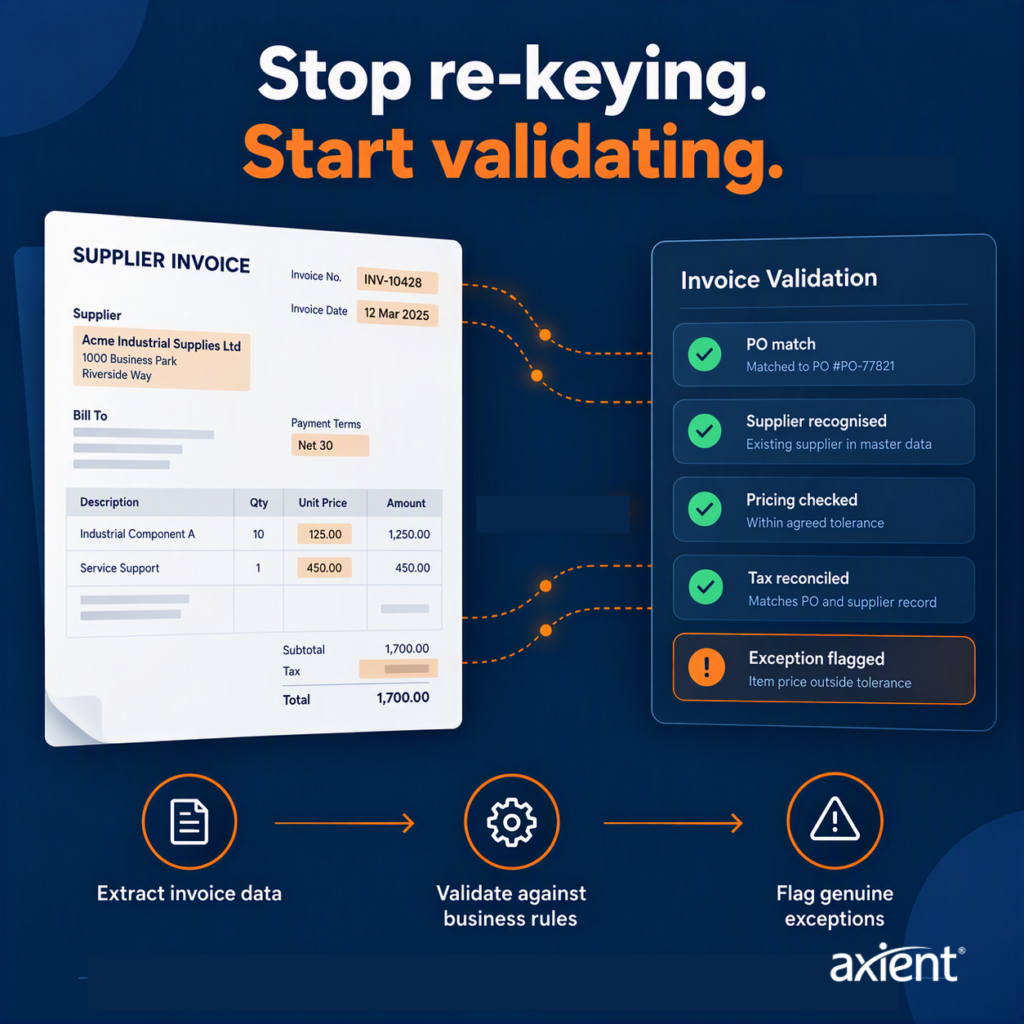
Sophisticated Intelligent Document Processing platforms do far more than extract fields from documents. They can compare multiple data sources, validate calculations, test mathematical expressions, reconcile line items, apply tolerances, identify anomalies and explain exceptions before determining whether a transaction can proceed automatically or should be reviewed by a person.
They can compare document information against ERP, CRM, finance, procurement and operational systems before a transaction proceeds.
Human in the loop doesn’t mean reviewing every transaction
This is where the expression “human in the loop” fits.
Routine transactions can continue through the process while exceptions are directed to the right person for review.
Measuring automation differently
For business managers and executives, the outcome is not simply structured data. It is reducing the number of routine decisions that require manual review.
One way to think about decision automation maturity is simple: how many transactions can move through a process without someone needing to review, validate or decide what happens next?
When routine work becomes straight-through processing, employees are free to focus on judgement, customer service, investigations and exception handling.
That is where many organisations will find their next productivity gains.
Digital transformation doesn’t end with capture
Digital transformation no longer ends when information is captured. It ends when the right action occurs automatically.
If your organisation is still validating, comparing and deciding manually after information is captured, there may be a significant opportunity to extend automation beyond extraction and into decision-making.
Bring us your document challenge
If your organisation is still validating, comparing and deciding what happens next manually, bring us the document challenge. We’ll help identify where Intelligent Document Processing, business rules and decision automation can reduce manual effort and support more consistent outcomes.